Home / Articles
Flashes, Floaters, and Blurred Vision: Could It Be a Retinal Problem?
Home / Articles
Flashes, Floaters, and Blurred Vision: Could It Be a Retinal Problem?
It often begins quietly.
A brief flash of light at the edge of your vision while working late. A few drifting specks that look like dust on your screen. Slight blur that doesn’t fully clear, even after blinking. Most people dismiss these changes as eye fatigue, dry eyes, or stress — especially in fast-paced cities like Seoul, where long hours, digital screens, and visual strain are part of everyday life.
But from a retinal specialist’s perspective, these symptoms deserve attention. Sometimes urgent attention.
This article explains what flashes, floaters, and blurred vision really mean, how they relate to the retina, and when these symptoms may signal a condition that should not wait.
The retina is a thin, delicate layer of nerve tissue lining the back of the eye. Functionally, it works like the camera sensor of your visual system — capturing light, converting it into electrical signals, and transmitting those signals to the brain through the optic nerve.
Every detail you see — text on a phone screen, faces across a room, street signs at night — depends on the integrity of this microscopic tissue.
Unlike the cornea or lens, the retina cannot be felt. There is no pain when something begins to go wrong. There is no “warning ache” the way you might feel with a muscle or joint injury. That’s why retinal problems often announce themselves indirectly — through visual disturbances rather than discomfort.
In other words, how quickly you respond to early symptoms often matters more than how severe those symptoms feel.
Flashes often appear as lightning streaks, camera-flash-like bursts, sparks, or flickers in peripheral vision. They are especially noticeable in dark environments or when moving the eyes quickly.
Importantly, these flashes are not caused by light entering the eye. Instead, they occur when the retina is mechanically stimulated. The most common reason is traction from the vitreous — the clear gel that fills the inside of the eye.
As we age, the vitreous gradually shrinks and becomes more liquid. When it pulls on the retina, it can stimulate retinal cells, creating the sensation of light even in complete darkness.
Clinically, flashes are one of the earliest warning signs of possible retinal stress.
Floaters are among the most misunderstood visual symptoms.
They may appear as:
Black dots or specks
Thread-like lines
Cobweb shapes
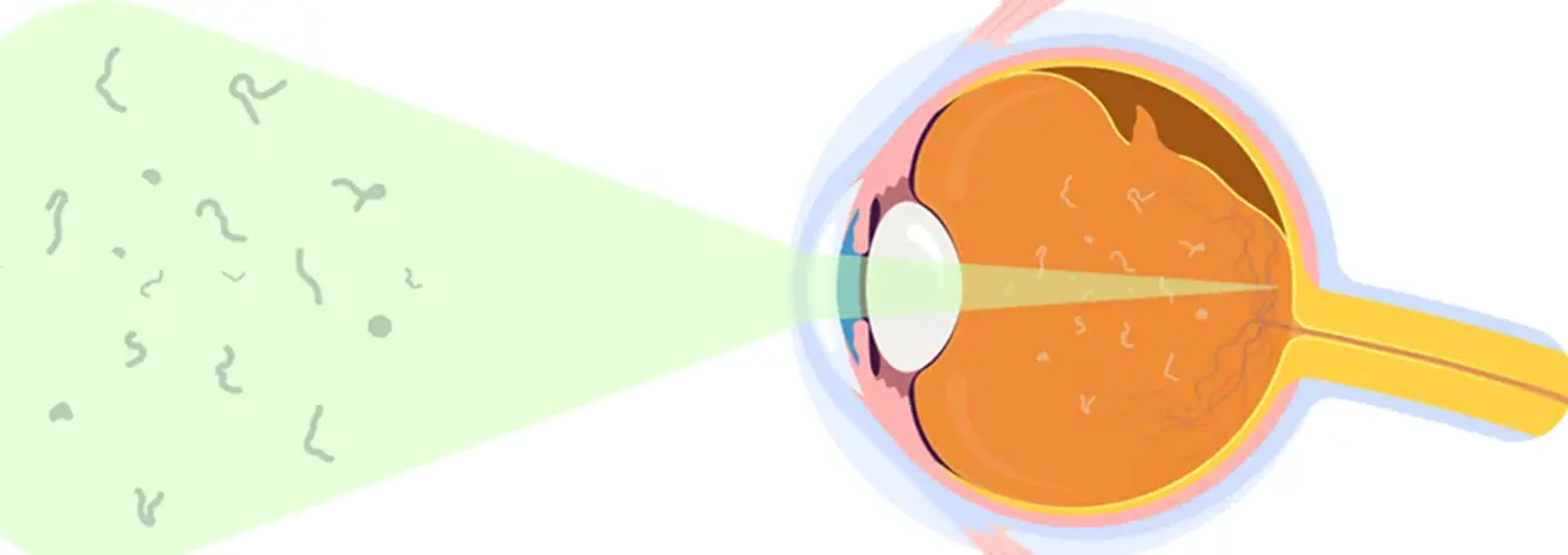
Transparent or gray shadows drifting across vision
Floaters move when your eyes move and often seem to “run away” when you try to look directly at them.
They are caused by tiny clumps, fibers, or condensations within the vitreous gel casting shadows onto the retina. Mild floaters are extremely common, especially after the age of 40, and many are harmless.
The concern arises when floaters:
Appear suddenly
Increase rapidly in number
Become darker or denser
Are accompanied by flashes or blurred vision
These changes can indicate vitreous hemorrhage, retinal tearing, or early detachment.
That description alone warrants an immediate retinal exam.
Blurred vision related to retinal problems feels different from refractive blur caused by nearsightedness, farsightedness, or astigmatism.
Patients may notice:
A smudge or shadow that doesn’t move
Straight lines appearing bent or wavy
Difficulty reading despite correct glasses
A dark curtain spreading from the side
Areas of missing or dim vision
Retinal blur often indicates that the retinal structure itself has been disrupted, whether by fluid, traction, swelling, or separation.
Although symptoms vary, many serious retinal conditions follow a predictable progression.
First, the vitreous gel inside the eye naturally changes over time. It shrinks, liquefies, and eventually may separate from the retina — a process known as posterior vitreous detachment. In most cases, this occurs without complications.
However, in certain eyes — particularly highly myopic eyes, eyes with weak peripheral retina, or eyes with previous surgery or trauma — the vitreous may adhere too strongly. When it pulls away unevenly, it can create excessive traction.
This traction can cause a retinal tear.
At this stage, vision may still seem relatively normal. Symptoms may feel intermittent or mild. Yet this is the most critical window for intervention. Laser treatment at this point can seal the tear and prevent further progression.
If a tear is missed or ignored, fluid can pass through the opening and accumulate beneath the retina. This lifts the retina away from the eye wall, leading to retinal detachment.
Once detachment occurs:
Vision loss can progress quickly
Surgery becomes necessary
Visual recovery becomes less predictable
The difference between these outcomes is often not symptom intensity — but timing.
You may be at higher risk for retinal problems if you have:
High myopia (nearsightedness)
A family history of retinal detachment
Previous eye surgery (including cataract surgery)
Eye trauma or sports injuries
Diabetes or vascular disease
Degenerative peripheral retinal conditions
In Korea, retinal issues are frequently seen in younger professionals with high myopia — individuals who may otherwise consider themselves healthy and too young for “serious” eye disease.
This is one reason why awareness, rather than age alone, is so important.
At GS Eye Center, patients often delay evaluation because:
There is no pain
Symptoms appear suddenly but stabilize
Vision still feels “mostly okay”
Online information minimizes floaters as normal aging
To be honest, most patients are surprised by how fast and straightforward treatment can be when retinal problems are caught early — and how serious the consequences can be when they are not.
Retinal specialists often see patients days or weeks after symptoms began, wishing they had come sooner.
A retinal evaluation is very different from a routine vision test.
Proper assessment requires:
Full pupil dilation
Careful examination of the peripheral retina
Advanced imaging such as optical coherence tomography (OCT)
Wide-field retinal imaging to detect peripheral tears
Many retinal tears occur far outside the central vision area and cannot be seen without dilation and specialized equipment. This is why quick screenings or optical shop exams are not sufficient when warning symptoms appear.
What people often overlook is how much thorough diagnostic testing determines long-term visual safety. Early detection is not luck — it’s the result of careful examination.
If a retinal tear is detected early, treatment is usually straightforward. Laser therapy can seal the tear, preventing fluid from passing underneath the retina. This is typically done on an outpatient basis and takes only minutes.
Recovery is minimal, and most patients return to normal activities quickly with appropriate monitoring.
If retinal detachment has already occurred, surgical repair becomes necessary. The type of surgery depends on the size, location, and duration of the detachment. Recovery and visual outcome depend heavily on how early treatment is initiated and whether the central retina is involved.
In retinal care, timing truly determines outcome.
Do not wait if you experience:
Sudden onset of many floaters
Repeated flashes of light
A shadow, curtain, or dark area in vision
Sudden blurred or distorted vision
Symptoms affecting one eye only
In these situations, same-day evaluation is strongly recommended.
But every new or worsening symptom deserves professional evaluation.
At GS Eye Center, our approach is careful and patient-focused: listen closely, examine thoroughly, and intervene only when truly necessary. Patients trust us not because we rush into treatment, but because we never dismiss early warning signs.
If you’re noticing flashes, floaters, or unexplained blur — especially if it feels new or different — trust that instinct. Vision changes are never “just in your head.”
If you’re unsure whether your symptoms matter, consider a comprehensive retinal evaluation at a specialized center like GS Eye Center in Gangnam, where advanced diagnostics and experienced care come together.